During my childhood, we used to chase and catch shotshoti* or dragonflies. We would stick a grass’ stem into their tails
so that they couldn’t fly as high and far any longer. We would usually catch the small ones that
fly low on the ground so it was more exciting when we’d see the bigger ones
that fly 1-2 meters above the ground and there were plenty of them!
Whenever our old
folks see those dragonflies flying above us, they would say that rainy days are
coming or a storm is brewing and I believed them. Up to these days, whenever I see dragonflies,
I am reminded of that old folks’ belief.
Years later, as I was talking with a Science teacher about
animals and old folks’ superstitions, I told her about the dragonflies. She then shared that whenever a storm is
brewing or rain is coming, there is a strong pressure in the sky so animals
like dragonflies couldn’t fly as high as they could. Ah, so that explains my old folks’
beliefs. I think they believed so because
they have had years of experience and keen observation skills.
The song speaks of a hunter who asked his mother to wake up and cook ava (gabi) so he would have a sikdop (packed food) to eat with a meat of a kombilan (female deer) as he goes hunting. Along his way, he met a kapitan.
It was early dawn so he had to ask Kabunyan to make the moon light his stony and weedy path and Kabunyan heard his prayer.
He was able to catch a healthy deer and the same kapitan he met earlier got mad (esemsem) (I don’t know why) and hit him with his kampilan.
The hunter was hit in his shoulder. He then ran for the shenget (headdress) of his mother and used it to stop the bleeding. His mother cried hard and cursed (in-avigan) the kapitan.
The people were then gathered and offered a makavas (deer?) to Kabunyan. The people ate well, so did the kapitan.
The Igorots referred to a Spaniard as kapitan. The use of the kampilan by the kapitan in the song proves that the kapitan was not a fellow Ibaloi. A kampilan is a saber/sword used by 19th century Spanish soldiers (Ibaloy book, 2011). If the kapitan was a fellow Ibaloy or a busol (enemy from other Igorot tribes), he would have used an Ibaloi’s sholos or etak (bolo) or other hunting weapon by other Igorots.
Apart from Dr. Pungayan's article, this is how I understood the song. In this day, the case would have been attempted or frustrated murder(?) and so back then, the leaders of the community had to settle the case. They needed to butcher an animal for the settling of the case that was why the kapitan was also there and ate with the community.The people were invited to witness the hearing of the case.The fact that the kapitan ate with the people and with the victim meant that the case was settled and all was well.That was how the Ibaloys settled cases in the past and to this day in some Ibaloy communities.This song might have also been written in the latter part of the Spaniards’ stay in the Philippines where some Spaniards were able to get through some parts of Benguet and settle with the Ibaloys. Otherwise, had it happened in the earlier times when the Ibaloys were more aggressive and resistant to the Spaniards, the kapitan (and his men) would have gone to the lowlands without their heads. Yes, the early Ibaloys were also headtakers, but that's another story.
In
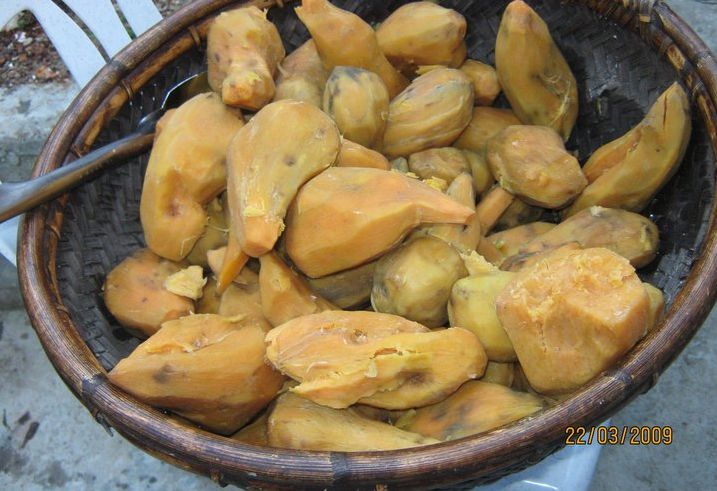
the distant past, the staple food of the Igorots was the dokto (sweet potato). Whenever there
is a ritual feast, dokto is served as a pintang, followed by a grilled and
chopped pork as the demshang. The rituals usually take time to finish so lunch is, almost always, served late
thus the need to serve pintang and demshang.
In
households, when there was no available rice, they made do with dokto for a meal(dokto e
mayshenon), probably, together with its otdo (tops). When dokto was not available, aba (taro), ube
(purple yam),or katimoro (cassava) may also be used.
Those
who were born earlier than the 1970s would claim that they grew up with dokto on
their table. They must have had pitied
themselves then for having grown up poor and having eaten less, but now that
only a few plant dokto, the Ibaloys crave for it. So, those who came before us must be luckier because dokto is now rarely served in Ibaloy ritual feasts,
weddings, reunions, and other gatherings. Nowadays, some Ibaloy kids eat French fries in fast food
restaurants and dokto might be unknown to some of them.
Dokto
is called the ‘sound fruit’ or 'musical fruit' because it makes one fart often. But isn’t farting one sign of a healthy
body? Whenever somebody is hospitalized,
the doctors and nurses would ask, “Have you farted yet?” several times to the
annoyance of the patient.
I remember in classrooms then, whenever a student wasn't paying attention, the teacher would say "Go home and plant camote!" I say, well, let's plant and eat more dokto indeed!
Pintang
– meal composed only of staple food (inepoy/rice, aba, dokto with no vegetables nor
meat (merienda for some)
Demshang
– meat eaten alone without rice nor dokto (pulutan)
INENI.Ineni
rice varieties have long stalks and take longer to grow before harvest.When it rains hard just before the harvest,
the rice plants may lie closer to the ground (mayjepes) and it makes it harder to harvest them.It is more backbreaking to harvest a nayjepes because one has to bend a
little to reach for them.Unlike when
they are standing straight, then it is more comfortable harvesting just
standing.
DAKEM. A small sickle used to harvest the ineni. The dakem cuts one or two rice stalks at a time. One can just imagine how long it takes to
harvest a sankavaneng (one rice field)
especially when it is nayjepes. It
usually takes two to three days of aduyon to harvest about 20 kavaneng (20 rice fields). This might had been one of the reasons that
Ibaloy farmers then had big families so that they have had a number of children
to help in farm work. TINAN-AY.
A bundle of harvested rice or pagey (with its stalk) is called sahey tan-ay tied with the use of a banban (bamboo strip). The tinan-ay (bundles of rice) are then
stored in a daktang (platform made of
bamboo) built near the ricefields. When
the tinan-ay are already dry enough (which
also means lighter to carry), they are brought to a rice storage near one's house.
AKSIW/SAKWIL/SAKSIL. A neck yoke: a bamboo bar with its ends a
little pointed but blunt, used to carry the tinan-ay
from the field to the house (or watwat from the feast to households).
SAFATAN
or ALANG. The tinan-ay are then brought to a safatan
or an alang.Safatan
is a storage above the shahidan
(cooking area) where the rice is further dried as it gets heated every time
somebody cooks. Alang or rice granary is a small hut or one-room house separate from the main
house.
TALTAG
- When the family needs rice, they bring out some tinan-ay and pound it on a katat
(dried cow or carabao hide) or on the ground (concrete for some in the 80’s)
until the rice grains get separated from the stalks. This task is called the taltag.
TAAP
OR TAAPAN. To make sure that there is
just the rice grains (now called irik),
the others mixed with it are cast away using a kiyag/digao (winnower). The
waste also now called taep/taap and
the rice stalk now called arutang. The taap
and arutang are actually not waste
but are used for other purposes.
KU-DAS
KUH-DAS. The irik
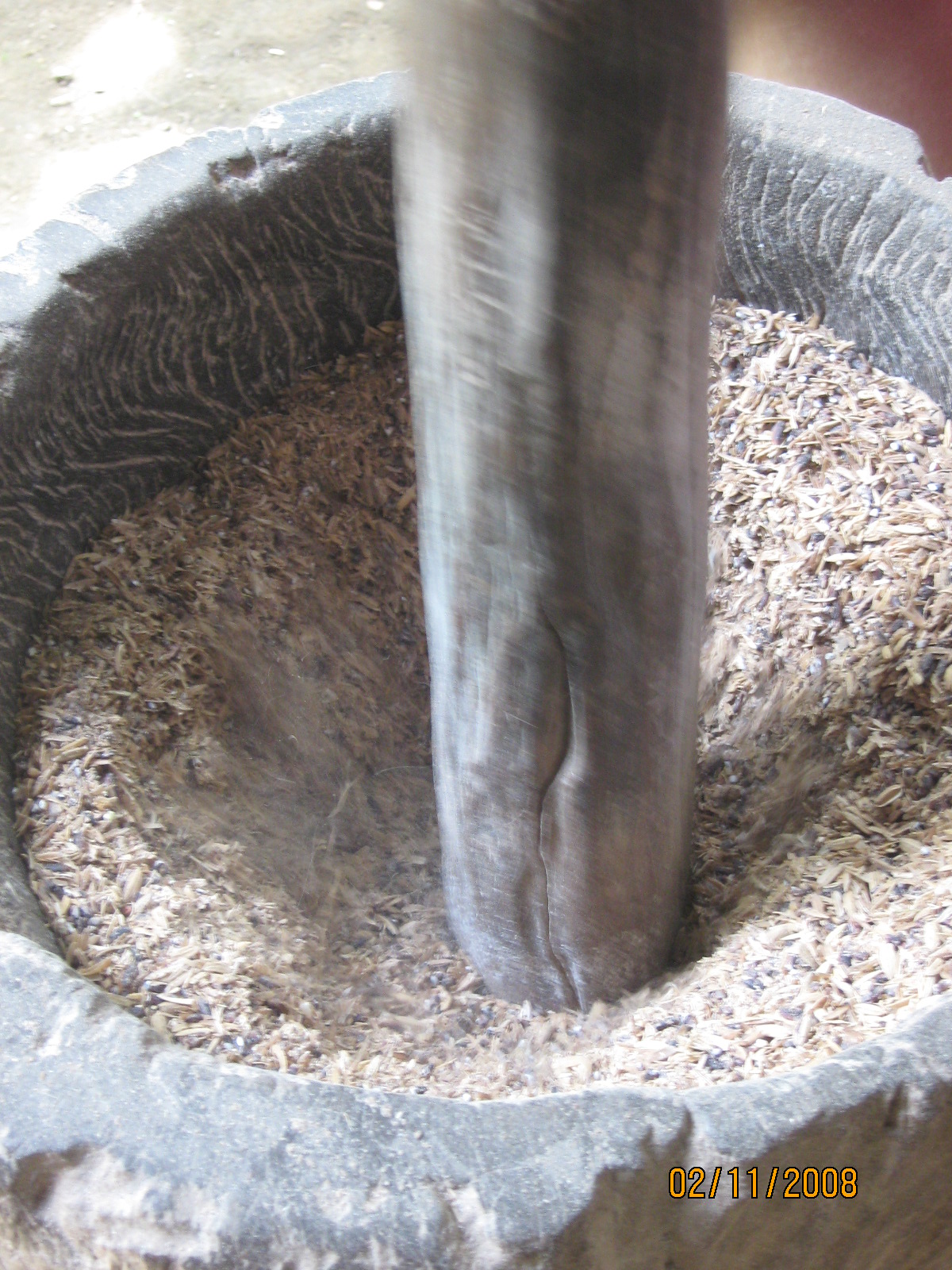
is then put to a bajoan/desong
(mortar) and pounded again using a bajo/da-do
(wooden pestle) until all of the rice grains are peeled and we now have the
rice (bekas) separated from the rice
hull. When the taltag is done by two or more persons together in one desong, it really is a sight to see because it creates a rhythm.To cast away the rice hull, one
has to use the kiyag again.
All of the above-mentioned tasks are done by
the family members together. They pound
rice together so one household has three to four da-do, otherwise, they borrow from their neighbors.
KUMPAY
Until
the early 80’s I experienced harvesting an ineni
rice variety, but with the advancement of Information Technology comes also the
advancement in rice technology. Today, farmers
rarely plant an ineni variety but now
use a kinafas variety. Kinafas only takes about three months
(or less) before harvest. The kumpay
now takes the place of a dakem. A kumpay cuts one handful at one time. Then there’s a machine called a tilyar (thresher) where the rice stalks are fed to
it and it does the job of separating the rice stalks and doing the taap as well. The irik
that comes out is already just purely irik. Then the dried irik is brought to a milling place to separate the rice from its
hull. The harvest of a kinafas rice only takes one day of aduyon,
half a day of separating the rice grains from the stalk (TILYAR), one day
drying the irik (BIDAG) (if the sun is out the whole day, that is, otherwise,
the irik has to be dried the next day
again), a few minutes to few hours of bringing the irik to a milling machine depending on the distance of the milling
machine from the house, and a few minutes of milling (KISKIS).
KAFAS
As
one might notice, the ineni takes much
more number of days to complete all tasks than the kinafas does. HOWEVER,
longer hours and days of work also mean longer hours and days of conversations
or adivay. A lot of conversations go on especially the ani or harvest. For children, they must have been learning a
lot from the exchange of ideas, jokes, and banters from the old folks and
farmers. The kinafas means that work is done faster and everybody works fast to
get the job done fast but it also means a limited time for conversation. Kinafas
means that there is time for other tasks in the farm like planting and tending
to other crops, having leisure time, a second crop for rice, etc but it also means that there is no longer
a need for a dakem, da-do/bajo, katat,
desong/bajoan, arutang, taap, aksiw, daktang, koh-das, taltag. A few more years and all these words will
disappear from the Ibaloy language, unfathomable by Ibaloy children. Worse than this, I think, is that, just like the
effect of staying long on facebook and texting the person next to you instead
of saying it to his face, Ibaloy families and neighbors have less and less time
for each other and no longer find time to REALLY talk to each other.
May the Ibaloys continue to share such stories to their children and
grandchildren, not only to preserve the terms but more and hopefully so to make the children
appreciate the hard labor their parents and ancestors had gone through, to make
them appreciate the blessings they are receiving today as most of them no longer experience such labor in the farm, to have more reasons to
talk about and to each other, and to make them be prouder of their Ibaloy
heritage.
Aduyon is the system of mutual and reciprocal work (Ibaloy Dictionary,
2011) as when a farmer schedules a day for planting rice (toned), he informs his neighboring farmers about it so they go to
his farm to help get the job done in one day, if possible. He compensates the neighbors’ help by going
to their farms on their scheduled day of planting as well. When there are two heads from a certain
household who went to help, he replaces it either with a two-days’ work or
sends two persons at one day. The host
of aduyon has to feed those who came, of course,-- morning and afternoon snacks, lunch, and sometimes even dinner. Other
Ibaloi dialects may call it obowan or
inatang (from the root word, atang, meaning “help”).
Also synonymous to aduyon is kamal which is defined in the Ibaloy dictionary as a “kind of
cooperative work – a gathering of neighbors to help someone who has a
heavy-labor project,” as in demolishing a house to build a new one. The host has to feed the people, of
course. It may also be a community
project like road-clearing as weeding or clearing of a landslide after a storm,
repair of broken pipeline, or cleaning
the community’s water reservoir. All
these with no pay nor compensation at all.
The food may come from anybody’s contribution. Aduyon and kamal may be used interchangeably
in some Ibaloy dialects. In the Tagalog language, it is called bayanihan. In elementary textbooks, this is shown through a picture where the community helps carry a nipa hut that needs to be transferred to another location.
Today, whenever there’s a need for road repair or clearing out the weeds, there’s a cash-for-work project by the Department of Social Welfare and Development (DSWD) or by the Department of Labor and Employment (DOLE), if the community is lucky, that is. The government either pays the workers a minimum amount or gives out free food, usually rice from the National Food Authority (NFA) and canned goods and/or noodles (I wonder if the Ibaloys consider the food lucky though, unless the brand of the noodles is Lucky. :D).
In case of farm work, when there are farmers who are done with their toned ahead of the others, they can help out in other farms but
then they ask for cash payment since they don’t need help in their farm any
longer. This is called pordiya, maybe
from the English term “(paid) per day” or Latin “per diem.”
This is another practice that is slowly disappearing not
only in the Ibaloy communities but in other Filipino communities as well. We observe it though during calamities when
there are casualties and Filipinos come out of their way to donate goods and
services to those in need.
I hope that the Ibalois and other Filipino communities still practice the bayanihan, aduyon or kamal, even without calamities
and tragedies, where we continue to prove and sustain our community spirit.
by Gamboa Alumit in Traditional Beliefs
and Practices in Benguet by Biano L. Baucas)
English translation:
Sih-kayo men
nan-ngilin, You who are now wedded,
It-itneng
jo’y bilbilin. Hear all the pieces of advice.
kayo
on-gasagasat, You shall have fortunes,
Kayo
on-gabagabay. You shall be progressive.
Angken
wara’y nowang, Even if there is a carabao,
Eg mebagke’n
ma-owang. It can’t be sent alone to work.
Angken
wara’y baha, Even if you have a cow, Eg met laeng
mabegka, It cannot be sent for an errand,
Shi piyan
ondawan to. In places where it should go.
Angken
wara’y kabajo, Even if you have a horse,
Eg mabegka’n
manbajo. It can’t pound rice for you.
Angken wara’y
molmol mo, Even if you have pigs,
Eg mabegka’n
mani-mol. They can’t feed other pigs.
Angken
shahel i kanshing, Even if you have goats,
Eg ira met
mamising. They can’t cook vegetables for viand.
Angken
shakel i manok, Even if you have chickens,
Eg ira
mabegka’d Antamok, They can’t be sent to Antamok Eg-mansayo
ni balitok. Where they can pan pieces of gold.
Egto inges i
anak, You cannot compare to children,
Kamon
manbu-bongakngak, If they make rhythmic sounds,
Kita ka mandaddadsak. They make us very happy.
Ba-diw is the most important and most common of the Ibaloi songs
and chants. It is a leader-chorus form
of poetry or group prayer where a chant in near monotone is given by a leader
and the rest in the crowd repeat some of the leader’s words in a laryngeal,
undulating tone, called the etob/asbayat.
The language of the ba-diw uses ancient Ibaloi words and ancient
pronunciations. It also uses synonyms,
poetic language and figures of speech.
At festive occasions, it can take the form of repartee. If someone understands the figurative
language of the ba-diw, he might take it up and respond. A ba-diw should fit the occasion, otherwise,
those in the crowd will not do the asbayat but reprimand the leader instead
(Ibaloy Dictionary, 2011).
Ba-diw is done on various occasions as weddings, wakes, and
ritual feasts. In ritual feasts and
wakes, Kabunyan, the ancestors, the spirits, and/or the
dead relative(s) are asked look over those whom
the dead has left behind, or the descendants of the ancestors. Elders pray for health,
prosperity, longer life, more blessings, more animals to care for, etc. In weddings, the elders ask Kabunyan and the
ancestors to bless the newly-wed. They also share pieces of advice for the couple thru their ba-diw. Some ba-diw may be funny but given much thought, they may have a deeper meaning.
NASPET – old
enough to be trusted to walk around on one’s own, unwatched – spoken of
children; also perhaps figuratively applied to teenagers (Ibaloy dictionary,
2011).
When an Ibaloi
mother has to go somewhere and has to leave her baby in the care of a relative,
she does so only when the baby is naspet already
because she is sure that her baby wouldn’t be crying the whole day looking for
her.
But beyond naspet children and teenagers, the
Ibalois are truly and fiercely independent and free. An Ibaloi can build his home on an area where his nearest neighbor could be an hour’s walk or three mountains away and
he can survive. He is not afraid of wild animals (if there still are up to these days)
nor of any visitors. He diligently tills
his land quietly and by himself. He
helps his neighbor if he can and asks for help if needs to. He is free to come, go and do as he pleases,
in his own time, in his own space.
As Claerhoudt had written, “How peacefully lives the Igorot in the wild mountains and
the hills. His song may well repeat what
the Flemish farmer sings of his misty meadows and fertile fields: “My
land is a land of peace, and of nature – lonesome but free!” (TheSongs of
a People: Igorot Customs in Eastern Benguet,
1966).